

My Dog Has Social Anxiety and I’m Starting to Think He’s the Healthy One (Part One)
I proudly own two Labradoodles — the kind of dogs genetically engineered to star in Christmas cards — plus my son’s emotional support animal, a 100-pound American Foxhound named Max who is technically thirty pounds overweight but has apparently decided that emotional support is a two-way street and his half comes in the form of peanut butter treats and bully sticks. I don’t judge because I can relate.
The Labradoodles are mine. The older one, Cookie, is perfect — sweet, gentle, loving, currently beating cancer with the quiet dignity of someone who has simply decided not to be inconvenienced by it. We adore her.
And then… there’s Luka.
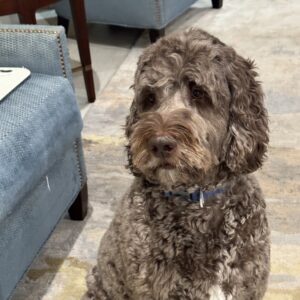
Luka is a stunning dark chocolate Labradoodle with a tuxedo chest and the emotional stability of someone who just received a text message that says, “We need to talk.” We love him. Deeply. This is not an “I love all my children equally” situation with fingers crossed behind my back — it’s just that Luka has… challenges. Challenges that have resulted in two month-long stays with expensive trainers, a Puppy Start class (which was, for the record, the ultimate failure), and most recently a visit to a dog behavioralist — also known in our house as Luka’s psychiatrist.
You see, Luka has severe social anxiety.
I don’t judge. I have anxiety too, though mine has never escalated to hiding under a table at the doctor’s office — although I did briefly consider it at my last gynecologist appointment. Nor have I ever nipped a repairman in the calf to encourage him to leave. And if I did, it would be after he fixed the problem and handed me the bill, not the moment he walked in the door. Luka, however, believes that if the dishwasher breaks, we should simply accept our fate. Hand washing builds character. And if the house eventually falls apart? We can move. No one needs to come inside. Ever.
What makes this worse is that Luka is a Labradoodle — a breed literally engineered for friendliness. This is like a golden retriever developing a gluten intolerance. It goes against nature. These dogs are called Doodles, which is not the name of a dog who fears eye contact. That is the name of a dog who shows up to a party wearing a lampshade.
Luka would like to leave the party before it starts.
Part of the problem is that he’s painfully adorable — he looks like a dog people are legally obligated to hug. Imagine being that cute while internally spiraling every time someone makes eye contact. Honestly, I can relate. But I’ve managed to function in society without biting anyone, which feels like the relevant distinction.
For years I tried everything: trainers, techniques, denial. At one point I sent him to a highly respected trainer who works with show dogs and, allegedly, celebrities. She assured me she could fix him, and I believed her — right up until four weeks became six. When he finally came home, he wasn’t better. He was worse. Significantly worse. Apparently, sending your anxious dog away for an extended period creates what experts call “abandonment issues,” which pairs beautifully with generalized anxiety — like wine and poor decisions.
Around this same time, I decided to get my own life together and hired a home organizer, after finally accepting that my personal system — watching episodes of Hoarders and feeling superior — was not working. If anything, it had lowered my standards.
The organizer was lovely. Truly. She loved dogs. Luka did not love her. Every day, before she’d even crossed the threshold, he would sprint to my office and wedge himself under my desk like a furry paperweight — no water, no food, no bathroom breaks — and simply wait her out. At one point I’m fairly certain he dissociated. When she left, he still didn’t believe it. One day I had to crawl under my desk and physically guide him out, army-crawl style, like we were escaping a hostage situation.
The only thing I didn’t do was bark. Not because it didn’t occur to me, but because I was genuinely afraid that I might say something offensive in dog language.
That was the moment I knew we needed professional help.
I called the vet, who referred me to a dog psychiatrist — and apparently there are not many of those. Which makes sense: Austin is already short on human doctors, so naturally the dog psychiatrists are booked through the next decade. I had actually tried contacting one years earlier and never heard back, which I’ve since attributed to the fact that I called twice in one week — once for Luka, and once for Max, who had bitten our other dog over a bone and earned his own referral. In retrospect, two psychiatric referrals from the same household in one week may have raised some red flags.
This time, however, I got through. Within minutes I received an intake form with a note at the top: “Please allow one hour to complete.” I laughed, then cried, then blocked off my afternoon. The form required a level of reflection I have not applied to my own life. At one point I genuinely wondered whether I would do this for one of my children. Maybe. For myself? Absolutely not. I’d simply accept my fate and live under the desk with Luka.
When the form asked for his emotional triggers, I initially typed “existing” — but since I was paying by the hour, I decided to be thorough. “Other dogs, strangers, familiar people he doesn’t like, loud noises, quiet noises… and Tuesdays.” That felt comprehensive.
An hour later, I finished. I felt hopeful. This man clearly knew what he was doing. Two days later, we had an appointment. I didn’t know what to expect. I didn’t know how he’d react. I didn’t know if a dog psychiatrist evaluation was the kind of thing that went smoothly or the kind of thing where your dog bites the psychiatrist and you have to pretend you’ve never met.
What I did know was that Luka had no idea he had a psychiatrist. No idea he had an appointment. No idea that his emotional triggers had been catalogued, submitted, and were currently in the hands of a professional.
Somewhere in my house was a lampshade with his name on it, and I was no longer certain it wasn’t a shared purchase.